
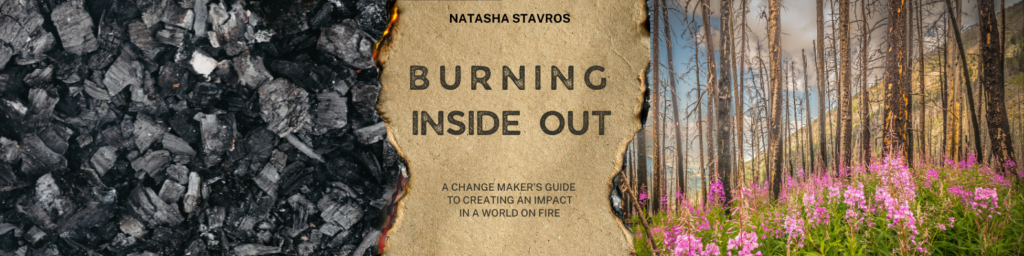
What is this book about?
The world burns, floods, dries up, and starves. Forests fall. Species vanish in the sixth mass extinction. We witness war, school shootings, and a deluge of how-to books promising solutions. Yet no one talks about the personal cost of being a changemaker.
In this practical guide, Natasha Stavros- a young, female scientist – navigates the male-dominated world of megafire science and technology at NASA’s world-famous Jet Propulsion Laboratory. In 30 practical lessons interwoven with stories from her life, she offers vital advice for how to change a broken system, even when the odds are against you. Lasting change, she teaches, is not impossible – it is intentional. We must change the world now, before it’s too late.
Who will enjoy this book?
Burning Inside Out is for you, if you are a…
- change maker in crisis dealing with burnout and emotional fatigue, feeling isolated or powerless against systemic resistance and looking for practical guidance beyond “how-to” tactics.
- woman in STEM or an underrepresented professional dealing with impostor syndrome, bias, and isolation, who is struggling to align personal values with your career path and who lacks relatable, authentic mentors.
- climate-conscious and justice-oriented reader who is overwhelmed and feel despair, skepticism of institutional solutions, and disconnected from impact that matters, especially with respect to climate change.
- fan of narrative nonfiction with a purpose, who is bored with shallow self-help and want lessons that respect your intelligence while fulfilling a craving for inspiration and application.
This book is honest and real. I have worried about burning bridges. There are about 10 people that I can think of off the top of my head who will grit their teeth and very likely hate me after reading this.
But, here’s the thing, they probably won’t read it. And if they do, it’s my story. I’m proud to feel empowered enough to write my own story. For a long time I’ve internalized other peoples’ narratives of me, and it’s burned me inside out.
Over the course of 2025, I have revealed the last chapter through my Substack: A Jester’s Musings. I hope that readers walk away from this book empowered to make a change in their lives, especially after reading the final chapter: Lesson #30 Claim your Power – Lead with Radical Acceptance and Be the Change.
Who is a change maker?
A change maker is anyone who lives boldly and authentically in a way that is different enough from the assumed, dominant system – that their mere existence begs question to the assumptions of the current system. Within Chapter 30, Lesson #30: Claim your power – lead with radical acceptance and be the change, the last chapter of the book, we discover that being a change maker is something with which you inherently identify.
Do I need a science background to understand it?
No! In fact, that’s the whole point of the book. I first documented NASA innovation processes by publishing the WKID (pronounced wicked) Innovation framework in the academic literature, but this only reaches a specific audience. I tried to expand my audience with an 11-minute master class, but alas, the book- Burning Inside Out is intended for a general audience.
I wanted to connect with people on a personal level, outside of an academic or intellectual pursuit. What we need today are change makers of all walks of life to take calculated risks for the high reward of changing the broken systems that are rapidly affecting every day life on Earth.
Story telling, especially the fireweed metaphor, is so central to the book because the basis of WKID Innovation is that change starts with understanding the wisdom of the system. Wisdom is applied understanding, often gained through experience. People can gain experience directly or through story telling. Stories are how humans have passed knowledge from generation to generation for millennia. By outlining the lessons of WKID Innovation through story, Burning Inside Out doesn’t just intellectually outline knowledge, but it embodies it’s origins.
Is this memoir, science writing, or a how-to guide?
Burning Inside Out is a lot of things. It is a narrative nonfiction how-to book. It is a change maker’s guide to creating an impact in a world on fire. Against the backdrop of innovation, Burning Inside Out covers science, technology, engineering, mathematics (STEM), fire ecology, data science, and psychology. Unlike other how-to books on innovation, it centers practical lessons through story telling.
The story arch follows the life of fireweed – a beautiful, bright pink flower that prospers after a fire has charred the landscape. It follows from seed to germination, growth, blossoming, burning, and regrowth. I tell the lessons of my 20 year career as a young woman in the man’s world of fire science and technology at NASA’s Jet Propulsion Laboratory.
How is this different from other books about fire or innovation?
Burning Inside Out is similar to disaster-focused books like Fire Weather, Young Men and Fire, the Big Burn, and The Ecology of Fear, in that it discusses the science and operations around wildfire management in North America. What makes it different is its systematic evaluation of the topic from technology through social systems. Additionally, the book uses fire ecology, the study of fire’s role in ecosystems, as an investigative tool of how systems work today. This concept is known as biomimicry, when our systems mimic designs and processes found in nature.
Unlike other innovation books, Burning Inside Out does not glorify innovation or the path of the innovator. It unveils the hard truths that a change maker must encounter in their commitment and service to adapt broken systems. The lessons do follow WKID Innovation, a framework that combines change management and system engineering, to construct intentional change of policy, economies, sociocultural factors, and technologies. It also goes a layer below the how-to by sharing a real-world example of applying the framework to the broken system of wildfire management in North America. It goes beyond self-help to relate to a reader on a personal level by sharing experiential wisdom through story-telling.
What is WKID Innovation?
WKID Innovation is a framework for change management and system engineering. It uses NASA system engineering principles and different system models to think holistically and intentionally about what you are designing and what effects it will have within the system you create. WKID Innovation was originally developed to help project managers work across different disciplines within their teams to guide them towards a goal of disruptive innovation. It can also be applied in program management, though its originally published use case was for product management.
What does “Burning Inside Out” mean?
When I first started writing the book, I called it Fuel the Change. I never loved the title because it felt generic. At one point, I called it Phoenix from the Ashes, but that had too many pop culture references and also didn’t convey the informative or prescriptive nature of the book.
When a friend suggested Burning Inside Out, it clicked. It aligned with the theme of fire as well as the emotional and metaphorical experience of a change maker. Over my twenty year career outlined in the book, being a change maker led to extreme burnout and alienation. The fire and passion within me died. At the same time, life persists after fire, and that’s a beautiful metaphor.
I loved how the title captured the information content, the prescriptive nature of the book as a change maker’s guide to creating an impact in a world on fire, fueled by internal passion and purpose, as well as the emotional story arc.
What will I walk away with after reading this?
I hope that you will walk away feeling seen and with a sense of connection, hope, and inspiration. I hope that you will walk away a little more wise and perhaps remember some science and nature facts along the way.
Is this book hopeful?
Yes, this book is hopeful. The book follows the story arc of fireweed, a flower that burns and grows back vibrant and bright. That should give you a good sense of how this book ends.
What makes this story timely right now?
It’s funny because when I started writing Burning Inside Out in 2020, I would have said that the timeliness of this book was around climate change and the rise of megafires, but as the years have turned and our political climate has changed as much as our Earth system climate.
This book’s relevance is ever more poignant now. In particular, when I started writing this book, my tagline was “a change maker’s guide to creating an impact in a world on fire”, but now – the book cover will state “Lessons on resilience through change.”
I write about resilience through change, because I believe in my heart of hearts that it is my service to live with courageous authenticity and intentionality.
After studying climate change for 20 years and contributing everything I could to the cause of a more sustainable, balanced, peaceful future for all life on Earth, I am experiencing burnout. Turns out that climate burnout is real. People who do the work day in, and out, get tired. “Don’t look up” wasn’t a comedy, it was a horror movie of our reality. It was my every day, not a 2 hour escape.
I write about resilience through change because the world needs you, the change makers, to keep showing up. As a change maker, you will get tired, eventually. How do you keep doing the work when seemingly everything we do is bigger than ourselves?
How do you balance storytelling with scientific accuracy?
No facts or scientific understanding of fire ecology or of Earth system science have been altered for storytelling. All of the fire and Earth system science in this book is backed and supported by peer-reviewed scientific literature. I decided not to distract from the story by putting in footnotes and references, however, all references can be found in my 40+ scientific publications on the topic. I have made every attempt to provide information that is accurate and complete. This book is not intended as a substitute for peer-reviewed scientific publications.
Are the events described factual?
This book represents the personal views and opinions of the author and does not reflect the positions or opinions of any organization, institution, or individual with which the author is or has been affiliated. Some names and characteristics have been changed or condensed, some events have been compressed, and some dialogue has been recreated. The content presented herein is based on the author’s own memories, personal documentation, perspective, and interpretation.
What is your AI Policy as an Author?
In the era of AI, it’s important to note that this book is more than intelligence, it’s wisdom – and that, cannot be done by Artificial Intelligence; it can only be done by human intelligence.
As such, I’d like to distinguish as an author that no generative artificial intelligence (generative AI) was used in the final production of this book including all text, the title, the cover, design, or any art used. All of the text was written and iterated by the author without aid from artificial intelligence. AI was used as a by-product of google searches. AI was also used to brainstorm marketing strategies including substack article titles and short descriptors for each social media audience. The substack articles are first written by the author, edited by the author, and uploaded to AI with the prompt to help find a title and short description. The author edits AI titles and short descriptions before final publication.
As the creator, author, and editor of all body text on the substack and in the book Burning Inside Out, I do not authorize use of my writings in any artificial intelligence platforms. Doing so constitutes a violation of copyright.
What is the publishing timeline?
December 2025: Sign book publishing contract with Amplify Publishing GroupJanuary 2026: Liability review and edit- February 2026: Copy edit
- March 2026: Finalize Manuscript and cover design begins
- April 2026: Finalize design and layout
- May 2026: Testimonials due
- June 2026: Production begins and record the audiobook
- July 2026: Audiobook post-production and launch marketing begins
- August 2026: Book printing
- September 2026: Early release of the book to early readers via annual paid subscription to Substack
- October – November 2026: Launch campaign and party planning
- December 2026: Launch the book!